September 29, 2026
TWO MEGATRENDS,ONE INVESTMENT: Emerging Markets’ Play in the Global Sports Revolution
by Peter Marber, PhD, FRSA, FRAS
My first Emerging Markets investment lesson came from my father. When he opened his first glove factory in China in 1986, he summarized the country’s long-term consumer potential this way:
“China has roughly one billion people. If every person ate just one more egg each week, that would mean 52 billion more eggs every year!”
In my memory, it became the “one billion more” lesson. The eggs were incidental; the incremental scale of one billion more consumers was the revelation.
My second great lesson in Emerging Markets came in grad school when I learned about Maslow’s Hierarchy of Human Needs (Exhibit 1). Socioeconomic development begins with necessities: more protein, clothing, housing, and household goods. As incomes rise, spending on necessities takes up a smaller portion, freeing more of the household budget for discretionary goods and desired experiences. And income has risen in Emerging Markets during this millennium.
Exhibit 1. Maslow’s Hierarchy of Human Needs
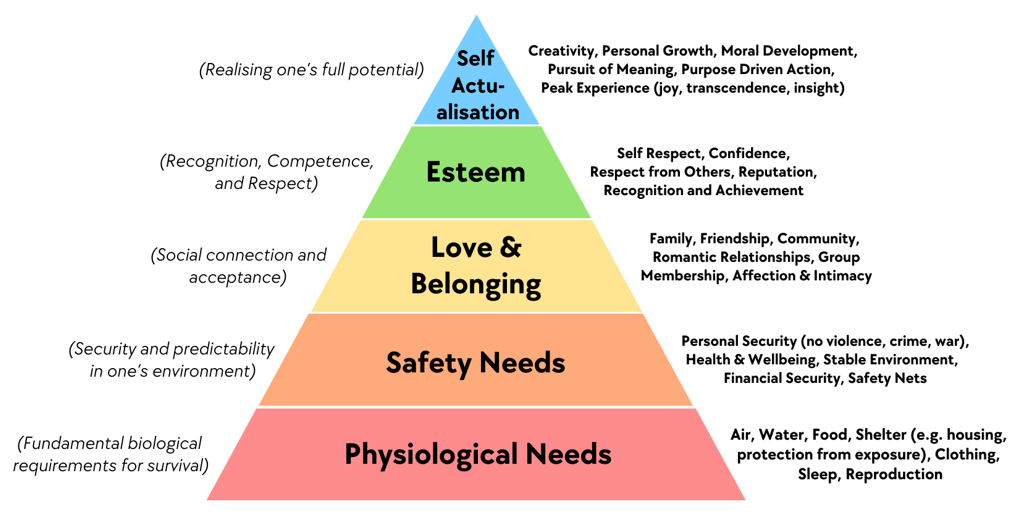
Sports are unique in that they combine entertainment (top of the pyramid) with identity and community (middle of the stack), and live scarcity. Sports may therefore be among the biggest beneficiaries of the rising prosperity in Emerging Markets – one more match, subscription, video post, jersey or stadium visit can reproduce my father’s scale effect.
That creates a compelling proposition: sports-related industries can monetize two megatrends in Emerging Markets—the rise of the consumer, and the institutionalization of sports as a private-markets asset class.
The First Megatrend: The Rise of the EM Consumer
The macroeconomic foundation and megatrend potential is formidable.
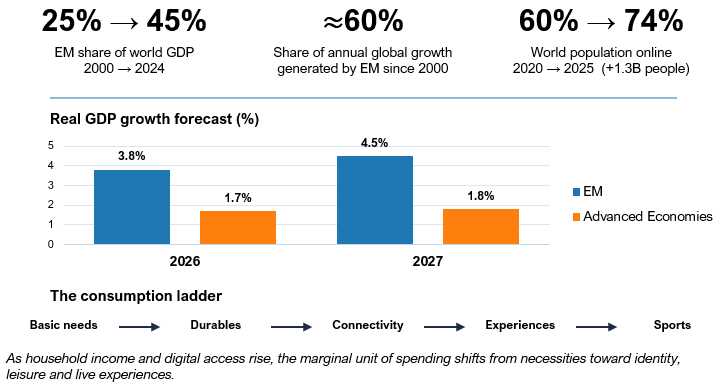
Developing economies now represent about 45% of world GDP, up from roughly 25% in 2000, and have generated about 60% of annual global growth since then (World Bank, 2025). The International Monetary Fund projects 4.5% GDP growth in 2027 for Emerging Markets, versus 1.8% for wealthier economies (International Monetary Fund [IMF], 2026).
GDP growth is not itself an investment thesis. Currency depreciation, weak governance and poor capital allocation can quickly erase nominal gains, while public EM equity indices often overweight banks, commodities and mature exporters.
The real challenge is transmission: how does rising national income become a durable investor cash flow? Sports can be a unique transmission mechanism.
An estimated 4.7 billion people in low- and middle-income economies—nearly four-fifths of the world’s internet users—were online in 2025. Mobile screens, streaming, and digital payments turn geographically distant supporters into measurable customers. Exhibit 2 shows the sequence: scale creates the market, income expands discretionary budgets, and connectivity makes consumers reachable.
Sports thus can convert attention and identity into recurring revenue. The wager is not merely that EM consumers will spend more, but that more of the marginal dollar will flow toward the sports products and experiences they already love.
Exhibit 2. Scale, Growth and Connectivity are Moving EM Consumption Toward Experience
Sources: World Bank (2025); International Monetary Fund, July 2026 WEO Update; International Telecommunication Union (2025).
The Second Megatrend: The Institutionalization Of Sports
Sports possess a quality that investors labor to create elsewhere: scarcity. There will never be thousands of Mumbai Indian cricket teams, New York Yankees, Flamengo soccer clubs, or national sports leagues with an authentic history. A successful competition restricts supply while deep loyalties can persist across generations.
Moreover, in an age of fragmented media and generative Artificial Intelligence (AI), live sports may become even more valuable. Scripted content can be reproduced endlessly; the human drama of sports cannot. Premium sports still assemble simultaneous audiences monetized through media rights, sponsorship, tickets, hospitality, merchandise, licensing, data, academies, and real estate.
Institutional capital agrees. Asia-Pacific sports M&A reached a record $3.69 billion through July 13, 2026—more than twelve times the volume a year earlier (Reuters, 2026a). Apollo Global Management describes sports as a $2.5 trillion ecosystem with substantial room for private credit and hybrid capital (Apollo Global Management, 2026). Developed-market auctions are already expensive. EM assets, whose revenues haven’t caught up with their audiences, may offer a more interesting hunt.
India’s Winning Model
India offers a great example. It is ahead of its EM peers in the sports investment game.
The Indian Premier League combines a huge digital audience with only ten franchises and centralized economics. Its business value reached an estimated $20.6 billion in 2026; media rights exceeded $6 billion, while pooled rights and sponsorship revenues give franchises high visibility (Reuters, 2026c, 2026d).
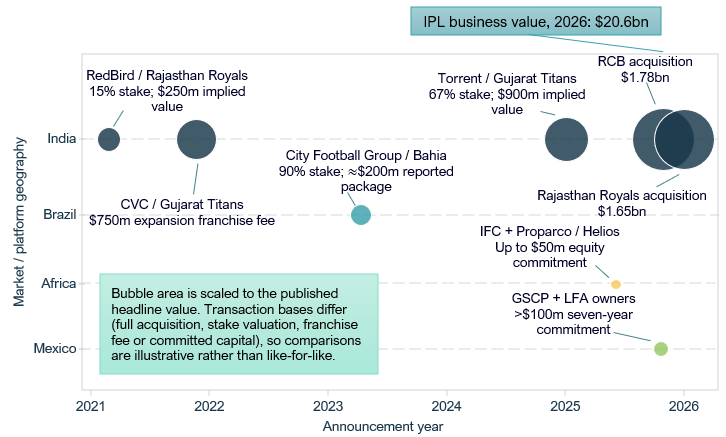
The M&A activity within the Indian sports industry has been busy! CVC Capital Partners acquired the Gujarat expansion franchise in 2021. In 2025, India’s Torrent Group agreed to buy 67% of the Gujarat Titans, while CVC retained 33%. Reuters estimated that CVC earned more than 350% in dollar terms in about four years, with the transaction valuing the team at $900 million (CVC Capital Partners, 2025; Reuters, 2026c).
RedBird Capital had entered Rajasthan Royals in 2021 at an estimated $250 million franchise valuation, demonstrating the potential reward for institutional capital that arrives before the asset class fully matures (Financial Times, 2021).
Global private equity supplied the capital and sports experience; an Indian conglomerate supplied credibility, commercial relationships and operating capacity. The local partner was not a concession: it was part of the moat.
This M&A pattern accelerated in 2026. Blackstone and David Blitzer’s Bolt Ventures joined India’s Aditya Birla Group and Times of India Group to acquire Royal Challengers Bengaluru (RCB) for $1.78 billion. RCB’s revenue had risen 73% in three years (Reuters, 2026b).
Soon afterward, a consortium led by the Mittal family and Adar Poonawalla agreed to acquire the Rajasthan Royals platform for $1.65 billion, including affiliated teams in South Africa and the Caribbean (Reuters, 2026e).
Exhibit 3 traces the shift from minority stakes and expansion fees to local-global partnerships and billion-dollar control deals. Domestic industrial groups, family offices and investment managers are becoming sophisticated buyers of sports intellectual property—not passive partners to foreign capital.
Exhibit 3. Selected Private-Capital Transactions in Emerging Markets Sports, 2021-2026
Sources: Reuters; CVC Capital Partners; IFC and Proparco; Global Sports Capital Partners; City Football Group; RedBird Capital Partners; Houlihan Lokey.
A Broader Emerging Market Playbook
Africa may offer an earlier entry point.
In 2025, the International Finance Corporation (IFC) and Proparco committed up to $50 million to Helios Sports and Entertainment Group, an Africa-focused platform spanning rights, events, infrastructure, retail, and hospitality. IFC projects Africa’s sports economy could reach $20 billion by 2035 (International Finance Corporation [IFC], 2025), with multiple investment possibilities in arenas and venue districts, ticketing platforms, production companies, or academies cultivating sports talent, among others.
Latin America, too, offers famous brands but often underdeveloped balance sheets and governance. Fortunately, there are positive signs that local and global players are partnering to institutionalize the opportunity for durable success.
For example, in 2021, Brazil’s SAF (Sociedade Anônima do Futebol) opened clubs to outside capital. Subsequently, UAE -controlled City Football Group acquired 90% of Bahia after overwhelming member approval, while Brazilian manager XP launched an R$800 million fund to purchase broadcast and commercial rights from 23 clubs (City Football Group, n.d.; Reuters, 2023).
Mexico provides another opportunity. New York-based Global Sports Capital Partners and local league owners committed more than $100 million over a seven-year span to completely overhaul its ecosystem and professionalize the Liga de Fútbol Americano through better media, branding, coaching and league operations (Reuters, 2025).
Eastern Europe and broader Asia add variations to the thesis.
In Central and Eastern Europe, transactions remain smaller and more locally driven: Czech energy investor Pavel Tykač acquired Slavia Prague from China’s CITIC, while Hungary’s MOL Group purchased a majority interest in Újpest FC (Reuters, 2023; Budapest Business Journal, 2024). These deals suggest that industrial capital may professionalize historic clubs before global private equity arrives at scale. Romania’s Dan Șucu has gone further, using Rapid București as a platform before acquiring 77% of Genoa for €45 million (Reuters, 2024).
Across Asia beyond India, sports M&A reached $3.69 billion by mid-July 2026. Red Bull’s purchase of 100% of Japan’s Omiya Ardija and the Asian University Basketball League’s Series A—backed by Blue Pool, Avenue Capital, Bolt Ventures, HSG, Nan Fung and Yao Ming—show that investors are targeting both under-commercialized clubs and scalable regional leagues alike (Reuters, 2026a; Asian University Basketball League, 2026).
Private Credit May Be the Better Play
In each of the cases above, investors are financing formalization: converting abundant passion into contracts, data and repeatable cash flows.
Interestingly, while equity ownership attracts headlines, private credit may offer a more scalable, better risk-adjusted entry for the EM sports space. It can finance the infrastructure around fandom without paying the highest auction price for the trophy. Teams and leagues need capital for venues, media production, academies and digital platforms. While banks may hesitate to lend against intangible franchise value, private lenders can instead structure claims on contracted broadcasting, sponsorship, ticketing and venue cash flows.
The dangers of poor structure are equally clear. A good example of a deal gone bad is Eagle Football, a multi-club holding company that included Brazil’s Botafogo, which borrowed roughly $400 million of high-cost debt. The group later defaulted, illustrating how payment-in-kind interest, opaque holding-company leverage and cross-club cash needs can overwhelm valuable underlying brands (Financial Times, 2025).
Underwriting must be conservative. Debt service should match the currency of revenues; contracted cash flows should be ring-fenced with reserves, covenants and realistic amortization. Repayment should come from operations—not speculative player sales or the assumption that another buyer will always pay a higher multiple.
This can align global and local interests. Private credit supplies growth capital without forcing a family, member association or industrial group to surrender a culturally sensitive asset. The borrower retains the institution; the lender finances its professionalization.
The Importance of a Game Strategy
Emerging Market sports is not a slam dunk. Investors face currency volatility, political and regulatory risk, uneven governance, relegation, player-cost inflation, concentrated media buyers, and passionate supporters who do not regard their club as a financial instrument. Scarcity can justify premium valuations, but it can also seduce investors into overpaying.
A winning model requires a local partner with a social license, disciplined governance, transparent league economics and a credible path from fandom to cash flow. Investors should favor rights that can be measured, contracted and protected—and never assume every large audience is immediately monetizable.
My father’s egg lesson endured with me because it revealed how small changes become transformational when multiplied at scale. Engel and Maslow, along with my three-plus decades investing in Emerging Markets, have taught me the multi-billion-person consumption story will not stop at food, clothing, and household goods. It will increasingly include experiences that express identity and belonging – as it has in more advanced economies.
In my opinion, the best Emerging Market sports investments will not require every consumer to become wealthy. They will require millions of consumers to spend a little more, a little more often, on something they already care about passionately.
Sources
Apollo Global Management. (2026, August 11). The financing gap in sports: Unlocking a $2.5 trillion opportunity. https://www.apollo.com/insights-news/insights/2025/12/the-financing-gap-in-sports-unlocking-a-dollar-2-5-trillion-opportunity
City Football Group. (n.d.). Bahia.
https://www.cityfootballgroup.com/clubs/bahia
CVC Capital Partners. (2025, February 12). Torrent Group to acquire majority stake in Gujarat Titans. https://www.cvc.com/media/news/2025/torrent-group-to-acquire-majority-stake-in-gujarat-titans/
Financial Times. (2021, June 23). India’s Rajasthan Royals cricket team valued at $250 million with U.S. stake. https://www.ft.com/content/9eef0a43-3ebf-41b4-8717-ffe3917d6bd7
Financial Times. (2025, October 9). Ares gives former Crystal Palace investor reprieve after $450mn debt default. https://www.ft.com/content/89b5a583-0803-4ee7-872f-8c374a4c72ac
Fukase, E., & Martin, W. (2020). Economic growth, convergence, and world food demand and supply. World Development, 132, 104954.
https://doi.org/10.1016/j.worlddev.2020.104954
International Finance Corporation. (2025, July 9). Boosting job creation in Africa’s sports sector. https://www.ifc.org/en/pressroom/2025/boosting-job-creation-in-africa-s-sports-sector
International Monetary Fund. (2026, July). World Economic Outlook update: Growth holds up, but remains uneven, as tech momentum offsets war drag.
https://www.imf.org/en/Publications/WEO/Issues/2026/07/08/world-economic-outlook-update-july-2026
International Telecommunication Union. (2025). Measuring digital development: Facts and Figures 2025.
https://www.itu.int/itu-d/reports/statistics/facts-figures-2025/
Reuters. (2023, August 31). XP launches fund to buy broadcast rights for Brazil soccer championship. https://www.reuters.com/sports/soccer/xp-launches-fund-buy-broadcast-rights-brazil-soccer-championship-2023-08-31/
Reuters. (2025, December 10). Kalil and Griffin out to transform Mexico’s American football league. https://www.reuters.com/sports/american-football-kalil-griffin-out-transform-mexicos-american-football-league-2025-12-10/
Reuters. (2026a, July 23). Asia’s rich swap sponsorships for stakes in sports as dealmaking hits record. https://www.reuters.com/legal/transactional/asias-rich-swap-sponsorships-stakes-sports-dealmaking-hits-record-2026-07-23/
Reuters. (2026b, March 24). Birla, Blitzer, Blackstone, Times of India consortium to buy IPL team RCB for $1.78 billion. https://www.reuters.com/sports/cricket/ipl-cricket-team-royal-challengers-bengaluru-sold-consortium-178-billion-2026-03-24/
Reuters. (2026c, February 17). Global private equity firms bowled over by Indian cricket league IPL. https://www.reuters.com/world/india/global-private-equity-firms-bowled-over-by-indian-cricket-league-ipl-2026-02-17/
Reuters. (2026d, July 29). IPL’s business value soars above $20 billion, says report.
https://www.reuters.com/world/india/ipls-business-value-soars-above-20-billion-says-report-2026-07-29/
Reuters. (2026e, May 3). Lakshmi Mittal, Poonawalla-led group to buy IPL franchise for $1.65 billion. https://www.reuters.com/sports/cricket/lakshmi-mittal-poonawalla-led-group-buy-ipl-franchise-165-billion-2026-05-03/
World Bank. (2025, January 16). Global economy stabilizes, but developing economies face tougher slog. https://www.worldbank.org/en/news/press-release/2025/01/16/gep-january-2025-press-release
DISCLOSURES & IMPORTANT INFORMATION
Key Risks of Investment in the Emerging Markets Strategy (the “Strategy”)
All investment involves risk, including the risk of loss. Investors should have the financial ability and willingness to accept the risk attendant to private credit funds and should consider the following key risks in conjunction with those set forth in the product’s definitive offering memorandum before deciding to invest.
Emerging Markets Credit Investments. Credit investments in emerging market issuers involve heightened risks relative to comparable investments in more developed markets. Emerging market jurisdictions may be characterized by greater political, economic, and legal uncertainty, which can adversely affect an issuer’s ability or willingness to service its debt obligations. Information regarding borrowers in these markets may be less comprehensive or reliable, as disclosure, accounting, auditing, and financial reporting standards may fall short of those commonly observed in the United States. In addition, creditor rights, insolvency regimes, and enforcement mechanisms in emerging market countries may be less developed or less predictable, potentially limiting the Strategy’s ability to enforce remedies or realize recoveries in the event of a default or restructuring.
Emerging Markets Direct Lending. Direct lending to borrowers located in emerging market countries involves material risks beyond those typically associated with similar lending activities in developed markets. Legal, regulatory, and judicial systems in emerging market jurisdictions may be less developed, less transparent, or less predictable, which can impair a lender’s ability to enforce contractual rights, exercise remedies, or realize collateral in a timely manner—or at all. Insolvency, restructuring, and foreclosure regimes may be uncertain or subject to inconsistent interpretation or application, creating heightened recovery risk following a default. In addition, borrowers in emerging market countries may be exposed to increased macroeconomic volatility, currency fluctuations, changes in law or regulation, capital controls, or government intervention, any of which may adversely affect cash flows and debt service capacity. Information available to lenders may be more limited or less reliable due to weaker disclosure, accounting, or auditing standards, making credit underwriting and ongoing monitoring more challenging. The Strategy may also face practical and operational impediments in monitoring borrowers, enforcing covenants, or exercising governance rights compared to direct lending in more developed jurisdictions.
Senior Secured Debt. First Lien Loans and Second Lien Loans. Collateral securing loans originated by the Fund may decrease or become valueless, fluctuate in value or be difficult to sell in a timely manner or to appraise. In particular, real estate is expected to comprise a substantial portion of the collateral securing the Fund’s loan portfolio. As such, the Fund will be exposed to the risks of the real estate market, including taxation, regulations and economic and political factors. Potential negative impacts from these risks include unfavorable changes in real estate values, operating costs, interest rates and property taxes. In the event of borrower default, these risks may reduce amounts that the Fund might otherwise have been able to recover from the borrower. Further, there can be no guarantee that the Fund will receive principal and interest payments according to a loan’s terms, or at all, or that the Fund will be able to collect on a loan should it be forced to use its available remedies.
Interest Rate Risk. Prices of fixed-income securities generally fall when interest rates rise. The longer the duration of a fixed-income security, the more susceptible it is to interest rate risk. Recent and potential future changes in monetary policy made by central banks and/or their governments are likely to affect the level of interest rates.
No independent verification. Certain information contained herein is based on or derived from information provided by independent third-party sources. Chicago Atlantic has not independently verified any such information. Chicago Atlantic and its affiliates make no representation or warranty, either express or implied as to the accuracy, completeness or reliability of the information or opinions contained in this material.
No advice given. The contents of this material are not legal, tax, accounting or investment advice or recommendations. Although prospective investors in Chicago Atlantic products will be given the opportunity to ask questions and receive additional information concerning the terms and conditions of investment and other relevant matters, prospective investors should carefully read the applicable confidential private placement memorandum or equivalent disclosure documentation, and should consult their own counsel, tax and financial advisors as to legal and related matters concerning any information described herein before making a decision to invest.
Benchmarks. Indices are not directly investable and are presented for illustrative purposes only, to show general market trends. They are not intended to imply that the Strategy is comparable to the indices either in composition or element of risk. EM HY Corporate performance is that of the JP Morgan CEMBI Broad Diversified High Yield Index, which is designed to track non-investment grade (high-yield) U.S. dollar-denominated corporate bonds issued by emerging market entities. US HY performance is that of the MSCI USD HY Corporate Bond Index, which measures the performance of US high-yield corporate bonds, capturing relative performance across credit markets. EM Corporates performance is that of the JP Morgan CEMBI Broad Diversified Investment Grade Index, which is designed to track the performance of U.S. dollar-denominated emerging market corporate bonds that are rated as investment grade. US IG performance is that of the MSCI USD IG Core Corporate Bond Index, which tracks the performance of US dollar-denominated investment-grade corporate bonds. EM Sovereign performance is that of the MSCI Emerging Markets Sovereign Bond Index, which tracks the performance of US dollar-denominated sovereign bonds issued by Emerging Market governments. US Government Bond Index performance is that of the MSCI U.S. Government Bond Index, which measures the performance of US Treasury securities across various maturities, representing the US sovereign bond market. DM Sovereign performance is that of the MSCI Government Bond Index – Developed Markets, which measures the performance of sovereign bonds issued by Developed Market governments.